The correct answer is the Bay of Bengal. Key Points
- On the shores of the Bay of Bengal, the temple at Konark was built in the 13th century.
- Konark Sun Temple, located in the East Odisha near the sacred city of Puri.
- Built in the 13th year by King Narasimha I (AD 1238-1264).
- Its scale, refinement and concept represent the strength and stability of the Ganga Empire as well as the value systems of the historical environment.
- The temple is designed in the shape of a colossal chariot.
- It is dedicated to the god sun.
- In this sense, it is directly and materially linked to Brahmanism and tantric belief systems.
- The Konark temple is widely known not only for its architectural grandeur but also for the intricacy and profusion of sculptural work.
- It marks the highest point of achievement of Kalinga architecture depicting the grace, the joy and the rhythm of life all its wondrous variety.
- It was declared a UNESCO world heritage site in 1984.
- There are two rows of 12 wheels on each side of the Konark sun temple.
- Sailors once called this Sun Temple of Konark, the Black Pagoda because it was supposed to draw ships into the shore and cause shipwrecks.
- Konârak is the invaluable link in the history of the diffusion of the cult of Surya, which originating in Kashmir during the 8th century, finally reached the shores of Eastern India.
 Additional Information
- Arabian Sea
- It is Located in the northern Indian Ocean, the Arabian Sea is bordered by Pakistan and Iran to the northwest, the Gulf of Aden, Guardafui Channel, and the Arabian Peninsula to the west, the Laccadive Sea to the southeast, and the Somali Sea to the southeast.
- The Arabian Sea has one of the world's three largest oceanic oxygen minimum zones, or "dead zones".
- Indian Ocean
- It is Located to the south of India, the Indian Ocean is the youngest of the Pacific and Atlantic oceans.
- The Java Trench, which stretches between the southern tips of Africa and Australia, is part of the Indian Ocean.
- Red Sea
- The Red Sea separates the coasts of Egypt, Sudan, and Eritrea from those of Saudi Arabia and Yemen.
- It contains some of the world's warmest and saltiest seawater.
- It is a part of the Indian Ocean and connects to it via the Bab-el-Mandeb Strait and the Gulf of Aden.
The correct answer Is Japan.
Key Points
Tokyo is the capital of Japan.
|
Country |
Capital |
|
Japan |
Tokyo |
|
Emperor |
Akihito |
|
Prime Minister |
Fumio Kishida |
|
Currency |
Japanese yen |
The Correct Answer is People's Republic of China.
 In News
- THOMAS & UBER CUP 2024: PEOPLE’S REPUBLIC OF CHINA CLINCH BOTH MEN'S AND WOMEN'S CROWNS.
Key Points
- China clinched top badminton nation, winning men’s & women’s titles at 2024 BWF Thomas & Uber Cup in Chengdu.
- First Men’s Singles Winner: Shi Yuqi.
- First Men’s Doubles Winners: Liang Weikeng & Wang Chang.
- First Women's Singles Winner: Chen Yufei.
- First Women's Doubles Winners: Chen Qingchen & Jia Yifan.
The correct answer is 'i-d, ii-c, iii-b, iv-a'
Key Points
- Matching Diseases with the Organism Responsible:
- i. Malaria - Plasmodium: Malaria is caused by the Plasmodium parasite, which is transmitted to humans through the bites of infected Anopheles mosquitoes.
- ii. Diarrhoea - Rotavirus: Diarrhoea can be caused by various pathogens, but Rotavirus is a leading cause of severe diarrhoea in infants and young children.
- iii. Typhoid - Salmonella: Typhoid fever is caused by the bacterium Salmonella Typhi, which is typically spread through contaminated food and water.
- iv. Cholera - Vibrio: Cholera is caused by the Vibrio cholerae bacterium, which is also usually spread through contaminated water and food.
The Correct Answer is Rajkumar Vishawakarma.
In News
- UP govt appoints ex-acting DGP Rajkumar Vishawakarma as Chief Information Commissioner.
Key Points
- The Uttar Pradesh government appointed former acting director general of police (DGP) Rajkumar Vishwakarma as the Chief Information Commissioner of the state.
- A 1988-batch Indian Police Service (IPS) officer, Vishwakarma retired from service in 2023.
- The government also appointed 10 information commissioners.
- The new information commissioners are senior journalist Mohammad Nadeem, Sudhir Kumar Singh, Girijesh Kumar Chaudhary, Swatantra Prakash, former IAS officer Shakuntala Gautam, Rakesh Kumar, Dilip Kumar Agnihotri, Rajendra Singh, Padum Narain (Dwivedi) and Virendra Pratap Singh.
- The information commissioners will have a term of three years each.
The correct answer is Sitar.
Key Points
- Pandit Ravi Shankar was a virtuoso sitar player and a composer who played a pivotal role in popularizing Indian classical music around the world.
- He was awarded the Bharat Ratna, India's highest civilian award, in recognition of his exceptional contribution to music.
- Ravi Shankar collaborated with several international musicians, notably George Harrison of The Beatles, which helped introduce sitar to western audiences in the 1960s.
- He was influential in the development of the fusion music genre, combining elements of Eastern and Western music to create unique sounds.
Additional Information
| Option | Details |
|---|---|
| 2) Sarangi | A bowed, short-necked string instrument from India, used in Hindustani classical music. |
| 3) Sarod | A plucked string instrument used mainly in Hindustani music, known for its deep, introspective sound. |
| 4) Veena | An ancient Indian stringed instrument, primarily used in Carnatic music, with a distinctive long neck and a resonating body. |
The correct answer is Andhra Pradesh.
Key Points
- Andhra Pradesh was the first state of India that was formed on a linguistic and cultural basis, which set a precedent for other states that were later reorganized on linguistic lines.
- This new state came into existence on 1st October 1953 following the demands of Telugu-speaking people to have a state of their own.
- The movement for a separate state was led by Potti Sreeramulu, a freedom fighter who undertook a fast-unto-death for the formation of Andhra Pradesh, which greatly added momentum to the cause.
- Following his death while fasting, the central government declared the formation of the state to prevent further civil unrest.
- It initially included primarily Telugu-speaking regions separated from the Madras state, which later became Tamil Nadu.
- However, it did not initially include the Telugu-speaking region of Hyderabad, which was incorporated later in 1956 during the major state reorganization.
Match List-I with List-II and select the correct answer from the lists using the codes given below-
|
List-I (Soil) |
List-II (Other Names) |
||
|
1. |
Black Soil |
A. |
Loamy soil |
|
2. |
Alluvial soil |
B. |
Laterite soil |
|
3. |
Red and Black Soil |
C. |
Regur soil |
|
4. |
Laterite soil |
D. |
Red sandy soil |
The correct answer is option 3.
Key Points
|
List-I (Soil) |
List-II (Other Names) |
||
|
1. |
Black Soil |
A. |
Regur soil(Black, Cotton, karel, Chernojam) |
|
2. |
Alluvial soil |
B. |
Loamy soil |
|
3. |
Red and Black Soil |
C. |
Red sandy soil |
|
4. |
Laterite soil |
D. |
Red sandy soil (Bhata) |
The correct answer is Silver.
Key Points
- The metal with the highest electrical conductivity among the options given is Silver.
- Here are a few points explaining this:
- Conductivity:
- Silver has the highest electrical conductivity of all elements.
- It's used in many industrial applications because of this property.
- Resistance to Corrosion:
- Despite being highly conductive, silver isn't always the first choice for an electrical conductor in practical applications because it tarnishes and corrodes more easily than some other metals.
- Cost:
- Silver is more expensive than many other materials.
- Copper, while not as conductive, is used more frequently because it's less expensive.
- Heat Sensitivity:
- Silver's conductivity decreases as it gets hotter, so it's not ideal for high-temperature applications.
- Malleability and Ductility:
- Silver is malleable and ductile, making it easier to draw into wires for electrical applications.
Additional Information
| Metal | Conductivity | Uses | Notable Characteristics |
|---|---|---|---|
| Lithium | Lower than silver, gold, and platinum | Batteries, lubricating greases, rocket propellants | Lightest metal, reacts readily with water and air, lowest melting point of all metals |
| Platinum | Lower than silver and gold, higher than lithium | Jewelry, catalytic converters, laboratory equipment | Highly resistant to wear and tarnish, great high-temperature stability |
| Gold | Lower than silver, higher than platinum and lithium | Jewelry, electronics, dentistry | Excellent resistance to most acids, most malleable and ductile pure metal |
In News
- Mumbai won the 42nd Ranji Trophy title in 2024.
Key Points
- Mumbai defeated Vidarbha by 169 runs on the final day of the season.
- Mumbai's spinners played a crucial role in bowling out Vidarbha for 368 runs.
- This victory marks Mumbai's first title win in eight years, since the 2015-16 season.
- Musheer Khan was the star performer for Mumbai with a second innings century, supported by Shreyas Iyer's 95.
- Mumbai set a daunting target of 538 runs for Vidarbha, ultimately clinching the title.
Additional Information
| Season | Champion | Runner-up |
|---|---|---|
| 2023-24 | Mumbai | Vidarbha |
| 2022-23 | Saurashtra | Bengal |
| 2021-22 | Madhya Pradesh | Mumbai |
| 2020-21 | Not held due to Covid-19 | - |
| 2019-20 | Saurashtra | Bengal |
| 2018-19 | Vidarbha | Saurashtra |
| 2017-18 | Vidarbha | Delhi |
| 2016-17 | Gujarat | Mumbai |
| 2015-16 | Mumbai | Saurashtra |
The correct answer is Jaipur.
Key Points
Amateur Kabaddi Federation of India (AKFI)
- The full name of AKFI's regulatory board is Amateurs Kabaddi Federation of India.
- It was established in 1973 and is headquartered in Jaipur. Hence, Option 3 is correct.
- It regulates the sport in India and also holds national and international tournaments.
- This body is affiliated with the Olympics Association, International Kabaddi Federation, and Asian Kabaddi Federation.
- It has been also recognized by the Ministry of Youth Affairs, Government of India.
The correct answer is UNHCR.
Key Points- UNHCR (United Nations High Commissioner for Refugees): The UNHCR has been awarded the Nobel Peace Prize twice:
- First in 1954
- Second in 1981 for their continued work to aid refugees for three decades.
Additional Information- Explanation for Other Options:
- IPCC (Intergovernmental Panel on Climate Change): Awarded the Nobel Peace Prize once, in 2007.
- IAEA (International Atomic Energy Agency): Awarded the Nobel Peace Prize once, in 2005.
- UNICEF (United Nations International Children's Emergency Fund): Awarded the Nobel Peace Prize once, in 1965.
In News
- 6 traditional products and crafts of Assam, including Bihu Dhol, Jaapi and Sarthebari bell metal craft, have been accorded GI tags.
Key Points
- Bihu Dhol, Jaapi, Assam Asharikandi Terracotta Craft, Assam Pani Mateka Craft, Sarthebari Metal Craft, and Assam Mising Handloom Products are the products that received the GI tags.
- These crafts are deeply rooted in Assam's heritage and culture.
- The GI tags were granted with support from organizations like NABARD and RO Guwahati.
- Padma Shri Dr. Rajani Kant, a GI Expert, facilitated the process.
- These crafts directly support nearly one lakh people in Assam.
- The certifications for the GI tags were confirmed in 2024, affirming the state's rich cultural legacy.
The correct answer is Articles from 5 to 11.Key Points
- The Constitution of India has provisions for citizenship under Part II, Articles 5 to 11.
- Article 5 talks about citizenship at the commencement of the Constitution.
- It states that any person who was born in India or either of whose parents were born in India or who has been ordinarily resident in India for not less than five years immediately preceding the commencement of the Constitution shall be a citizen of India.
Additional Information
- Article 12 defines who is considered a person for the purposes of the Constitution and Article 13 provides for the laws inconsistent with or in derogation of the fundamental rights to be void.
- Articles from 7 to 14 talk about the right to equality, right to freedom, right against exploitation, right to freedom of religion, cultural and educational rights, and right to constitutional remedies.
- Articles from 12 to 35 talk about fundamental rights, specifically the right to equality, right to freedom, and right against exploitation.
The Correct Answer is All state government authority Not transfers to the federal government during a national emergency.
Key Points
- The first National Emergency was declared in India on 26 October 1962 during the India-China war.
- National Emergency in India has been declared 3 times - 1962 (China war), 1971 (Pakistan war), and 1975 (Internal Disturbances).
- National Emergency can be proclaimed by the President when he/she perceives threats to the nation from internal and external sources or from financial situations of crisis.
- National Emergency is mentioned in Article 352.
- National Emergency can only be declared on grounds of "External aggression or war", also called an External Emergency & on the ground of "armed rebellion".
- Article 352 of the Indian Constitution allows the president to declare a national emergency.
- Only after obtaining a written recommendation from the cabinet may the president declare a national emergency.
- Within one month, both chambers of Parliament must ratify the declaration.
- With a special majority, it can be extended for another six months.
- Dr. S Radhakrishnan declared the first National Emergency in India on October 26, 1962.
- NATIONAL EMERGENCY
- Under Article 352, the President can declare a national emergency when the security of India or a part of it is threatened by war or external aggression, or armed rebellion.
- It may be noted that the president can declare a national emergency even before the actual occurrence of war or external aggression or armed rebellion if he is satisfied that there is an imminent danger.
- The President can also issue different proclamations on grounds of war, external aggression, armed rebellion, or imminent danger thereof, whether or not there is a proclamation already issued by him and such proclamation is in operation.
- This provision was added by the 38th Amendment Act of 1975.
Additional Information
- Effects of National Emergency
- A proclamation of Emergency has drastic and wide-ranging effects on the political system. These consequences can be grouped into three categories:
- Effect on the Centre-state relations
- While a proclamation of Emergency is in force, the normal fabric of the Centre-state relations undergoes a basic change. This can be studied under three heads, namely, executive, legislative and financial.
- Executive: During a national emergency, the executive power of the Centre extends to directing any state regarding the manner in which its executive power is to be exercised.
- While a proclamation of Emergency is in force, the normal fabric of the Centre-state relations undergoes a basic change. This can be studied under three heads, namely, executive, legislative and financial.
- Effect on the Centre-state relations
- Financial: While a proclamation of national emergency is in operation, the President can modify the constitutional distribution of revenues between the center and the states. This means that the president can either reduce or cancel the transfer of finances from the Centre to the states.
- Effect on the Fundamental Rights
- Articles 358 and 359 describe the effect of a National Emergency on Fundamental Rights.
- Article 358 deals with the suspension of the Fundamental Rights guaranteed by Article 19, while Article 359 deals with the suspension of other Fundamental Rights (except those guaranteed by Articles 20 and 21).
The correct answer is Yoga for Self and Society.
In News
- The theme for International Day of Yoga (IDY) 2024 is ‘Yoga for Self and Society’.
Key Points
- This theme highlights yoga's dual role in fostering individual and societal well-being.
- Yoga nurtures physical, mental, and spiritual growth while promoting societal harmony.
- The theme reflects the profound impact of yoga on communities, as stated by Shri Prataprao Jadhav, Union Minister of State for Ayush.
- The enthusiastic participation of millions in recent years showcases yoga's influence on society.
Additional Information
- International Day of Yoga
- Proposed by Prime Minister Narendra Modi to the United Nations General Assembly (UNGA) in 2014.
- Celebrated annually on June 21st since 2015.
- Aims to raise awareness about the benefits of practicing yoga worldwide.
- Has set four Guinness Book of World Records in the last 10 years.
- Shri Prataprao Jadhav
- Union Minister of State for Ayush (Independent Charge).
- Emphasized the theme ‘Yoga for Self and Society’ during the 2024 IDY celebrations.
Match List-I to List-II and select the correct answer.
| List - I (Grassland) | List - II (Location) | ||
| (a) | Campos | (i) | Australia |
| (b) | Pampas | (ii) | Venezuela |
| (c) | Down | (iii) | Argentina |
| (d) | Llanos | (iv) | Brazil |
The correct answer is (a) - (iv), (b) - (iii), (c) - (i), (d) - (ii).
Key Points
| List - I (Grassland) | List - II (Location) | ||
| (a) | Campos | (iv) | Brazil |
| (b) | Pampas | (iii) | Argentina |
| (c) | Down | (i) | Australia |
| (d) | Llanos | (i) | Venezuela |
Additional Information
- Campos is a type of Brazilian grassland that is characterized by low and sparse vegetation.
- Pampas is a fertile South American grassland that is mostly used for grazing livestock.
- Down is a type of Australian grassland that is characterized by tall and dense vegetation.
- Llanos is a tropical grassland that is mostly found in Venezuela and Colombia. It is used for cattle ranching and farming.
The correct answer is Option 4.
Key Points
- MANAS Biosphere Reserve is located in the state of Assam in India.
- Biosphere reserves are areas of land, coastal or marine ecosystems recognized by UNESCO (United Nations Educational, Scientific and Cultural Organization) as having important ecological, biological and cultural value. They are designed to promote the conservation of biodiversity, support sustainable development, and foster scientific research and education.
- Biosphere reserves are typically composed of three zones:
- The core area, which is strictly protected and serves as a reference for the natural ecosystems and biodiversity of the region.
- The buffer zone, which surrounds the core area and is designated for activities that are compatible with conservation, such as sustainable agriculture, forestry, and ecotourism.
- The transition zone, which is the area outside of the buffer zone where human activities are more intense and where the emphasis is on sustainable development, community involvement, and cultural preservation.
- Biosphere reserves aim to balance conservation and development by promoting sustainable use of natural resources, fostering local economic development, and promoting cultural diversity. They also serve as important sites for scientific research, monitoring and education, and help to raise awareness about the importance of protecting our natural environment.
Additional Information
- Tripura is a state located in the northeastern region of India. It is bordered by Bangladesh to the north, south, and west, and by the Indian states of Assam and Mizoram to the east. The capital of Tripura is Agartala, and the state covers an area of 10,491.69 square kilometers. As of 2021, the population of Tripura is estimated to be around 4 million people.
- Manipur is a state located in northeastern India, bordered by Nagaland to the north, Mizoram to the south, Assam to the west, and Myanmar to the east. The capital city of Manipur is Imphal. The state has a diverse population, with various ethnic groups and languages, and is known for its rich culture and traditions.
- Meghalaya is a state located in the northeastern region of India: Meghalaya is one of the Seven Sister States of northeast India. It is bordered by Assam to the north and northeast, Bangladesh to the south and southwest. The state capital is Shillong.
The correct answer is Japan
In News
- In 2023, India made significant advancements in the solar power sector, achieving a milestone that positioned it as the world's third-largest generator of solar energy.
Key Points
- The country surpassed Japan, which was previously holding the position, marking a notable jump in India's ranking from ninth in 2015.
- The leap was highlighted in a report by the global energy think tank Ember, with data indicating that solar energy now contributes 5.5% globally, with India generating 5.8% of its electricity from solar sources.
- India's rapid increase in solar power generation is part of its broader commitment to renewable energy, showcasing a successful transition towards a renewables-powered future.
- The drive behind this growth stems from India's goal to significantly scale up its renewable energy capacity, aiming to triple it by 2030, aligning with global efforts to mitigate climate change through reduced carbon emissions and a decarbonized electricity sector.
Additional Information
- India's solar power installed capacity was 81.813 GWAC as of 31 March 2024.
- India has established nearly 42 solar parks to make land available to the promoters of solar plants.
- The International Solar Alliance (ISA), proposed by India as a founder member, is headquartered in India.
- Gujarat is one of India's most solar-developed states.
- Rajasthan is also home to the world's largest Fresnel type 125 MW CSP plant at the Dhirubhai Ambani Solar Park.
Match the mountain ranges in column-A with their states in column-B.
|
Column – A (Mountain range) |
Column – B (State) |
||
|
a. |
Aravali mountain |
1. |
Himachal Pradesh and Uttarakhand |
|
b. |
Vindhya range |
2. |
Kerala and Karnataka |
|
c. |
Western ghat |
3. |
Rajasthan |
|
d. |
Himalaya range |
4. |
Madhya Pradesh |
The correct answer is a - 3, b - 4, c - 2, d - 1.
Key Points
- The Aravali mountain range is located in the state of Rajasthan.
- The Vindhya range passes through the state of Madhya Pradesh.
- The Western Ghats traverse the states of Kerala and Karnataka.
- The Himalaya range spans across the states of Himachal Pradesh and Uttarakhand.
Additional Information
- Aravali Mountain Range:
- The Aravali range is one of the oldest mountain ranges in the world.
- It spans approximately 692 km in a northeastern direction across Indian states such as Gujarat, Rajasthan, Haryana, and Delhi.
- Vindhya Range:
- The Vindhya range runs parallel to the Narmada river in central India.
- This range forms the southern boundary of the Malwa Plateau.
- Western Ghats:
- The Western Ghats, also known as Sahyadri, are a UNESCO World Heritage site.
- They cover a stretch of 1,600 km parallel to the western coast of the Indian peninsula.
- Himalaya Range:
- The Himalayas are the highest mountain range in the world, home to Mount Everest.
- This range extends across five countries: Bhutan, India, Nepal, China, and Pakistan.
The correct answer is Purnia.
Key Points
- Purnia is not a part of the north-western alluvial/loamy plains in Bihar.
- Purnia is located in the northeastern part of Bihar and is a part of the Gangetic plains.
- It is known for its fertile soil suitable for rice cultivation.
- Muzaffarpur, Begusarai, and Samastipur districts are part of the Gangetic Plains in Bihar, specifically the northwestern part known for its alluvial and sandy loam soil which is fertile and suitable for the farming of various crops.
Additional Information
- Piedmont Swamp Soil: This soil is swallowing too deep over bedrocks and pebbles. Swamp soil is mostly clayey, rich in organic matter and neutral reaction. This is mostly found in the Northwestern Champaran district.
- Terai Soil: Terai soil is grey to yellow and neutral to moderately acidic in reaction. The soil of lowland Terai is more fertile than upland terai. This is mostly found in the northern part of Bihar nearby the border of Nepal and the foothill of the Himalayas.
- Gangetic Alluvium Soil: It is generally fertile in Bihar plain but regular tillage without application of manure has costs low organic content. Gangetic alluvium soil is mostly loamy with varying thickness. It is thicker towards the north and thinner towards the south.
- Karail-Kewal Soil: This is heavy clay soil (alkaline feature). This soil is found in Rohtas to Gaya, Aurangabad, Jahanabad, Munger, and Bhagalpur. This soil is best suited for rice and rabi crops like wheat, linseed, pulses, and gram.
The correct answer is Option 4.
Key Points
- Among the surface-to-surface missiles developed by India, the most prominent one is the Agni series.
- The Agni missiles are a family of medium to intercontinental range ballistic missiles developed by the Defense Research and Development Organization (DRDO) of India.
- The Agni series includes missiles such as Agni-I, Agni-II, Agni-III, Agni-IV, and Agni-V, with varying ranges and capabilities.
- These missiles are designed to be launched from land-based platforms and can deliver conventional or nuclear warheads to targets located on land.
Additional Information
- The Javelin missile is not developed by India but is actually a portable anti-tank missile system developed by the United States.
- It is a shoulder-fired, fire-and-forget missile that can be operated by a single soldier.
- The Javelin system is designed to engage and destroy enemy armored vehicles, including tanks, from various ranges and angles.
- The AIM-120 Advanced Medium-Range Air-to-Air Missile (AMRAAM) is an air-to-air missile primarily developed by the United States.
- It is designed for use by fighter aircraft to engage and destroy enemy aircraft at medium to long ranges.
- The AMRAAM missile is widely used by the U.S. Air Force and has also been exported to numerous countries around the world.
- The Spike missile is a family of multi-purpose, man-portable, anti-tank guided missiles (ATGM) developed by the Israeli company Rafael Advanced Defense Systems.
- It is designed to engage and destroy armored vehicles, including tanks, as well as other targets such as fortified positions and helicopters.
The correct answer is Kalpana Chawla
Key Points
- The Edge of Time is a biography of Kalpana Chawla, an India-born NASA astronaut.
- The book is written by her husband, Jean-Pierre Harrison, and covers her life from birth in India to graduate studies in the US, followed by an aerospace career culminating in her 1994 selection into the NASA astronaut corps.
- It details her astronaut training and two space shuttle flights, STS-87 in 1997, and the ill-fated STS-107 in 2003.
Additional Information
| Personality | Biography/Autobiography |
| Sania Mirza | Ace against odds |
| Mary Kom | Unbreakable |
| Dhyan Chand | Goal |
Key Points
- The Fourth Five-Year Plan of India was introduced under the leadership of Indira Gandhi.
- It spanned from 1969 to 1974.
- The main objectives of this plan were growth with stability and progressive achievement of self-reliance.
- During this period, India faced several challenges, including droughts, food shortages, and a significant influx of refugees from East Pakistan (now Bangladesh).
- Key initiatives during this plan included the Green Revolution to increase agricultural productivity and measures to control inflation.
Additional Information
- Indira Gandhi, the first and only woman Prime Minister of India, played a crucial role in shaping India's economic policies during her tenure.
- The Five-Year Plans are a series of centralized and integrated national economic programs, which were modeled after the Soviet Union's planning system.
- The Planning Commission of India was responsible for drafting and implementing these plans until it was replaced by the NITI Aayog in 2015.
- The Fourth Plan also focused on the expansion of the public sector and aimed at reducing inequalities in income and wealth distribution.
The correct answer is Surendranath Banerjee.Key Points
- Indian Association:-
- It was founded in 1876 in Calcutta (now Kolkata) by Surendranath Banerjee and Anand Mohan Bose.
- Indian Association was a political organization that aimed to promote the interests of the Indian community and to work towards the attainment of political rights and freedom from British rule.Indian Association played a significant role in the Indian National Movement and was one of the first organizations to demand self-government and representation for Indians in the British colonial administration.
- Surendranath Banerjee:-
- He was a prominent Indian nationalist leader and a member of the Indian National Congress.
- He was also a journalist, lawyer, and a member of the Bengal Legislative Council.
Additional Information
- Dada Bhai Naoroji:-
- He was a prominent Indian nationalist leader and a member of the Indian National Congress.
- He was also a scholar, social reformer, and a member of the British Parliament.
- He is known for his theory of the "drain of wealth" from India to Britain and his advocacy for Indian self-rule.
- Gopal Krishna Gokhale:_
- He was a prominent Indian nationalist leader and a member of the Indian National Congress.
- He was also a social reformer, educator, and a member of the Bombay Legislative Council.
- He is known for his advocacy for constitutional reforms, education, and social justice.
- Pheroz Shah Mehta:-
- He was a prominent Indian nationalist leader and a member of the Indian National Congress.
- He was also a lawyer, journalist, and a member of the Bombay Legislative Council.
- He is known for his advocacy for civil liberties, education, and social reform.
(148, 126, 104), (98, 76, 54)
(NOTE : Operations should be performed on the whole numbers, without breaking down the numbers into its constituent
digits. E.g. 13 – Operations on 13 such as adding /deleting /multiplying etc. to 13 can be performed. Breaking down 13 into 1
and 3 and then performing mathematical operations on 1 and 3 is not allowed)
The logic followed here is:
Logic: (1st number + 3rd number) ÷ 2 = 2nd number.
Now,
For, (148, 126, 104)
⇒ (148 + 104) ÷ 2
⇒ 252 ÷ 2 = 126.
For, (98, 76, 54)
⇒ (98 + 54) ÷ 2
⇒ 152 ÷ 2 = 76.
Similarly, for (157, 126, 113)
⇒ (157 + 113) ÷ 2
⇒ 270 ÷ 2 = 135.
Hence, the correct answer is "Option 1".
Time duration between 9 AM to 3 PM = 6 hours
In one hour, hour hand rotate = 30°
In 6 hours, hour hand rotate = 30 × 6 = 180°
Hence, the correct answer is "180°".
Given: The seventh day of a month is three days earlier than Friday.
So, the seventh day of the month is a Tuesday.
Now, the number of odd days from the seventh to the nineteenth of a month is as follows:
12 odd days → 12/7 = 1 one week and 5 odd days.
Therefore, 5 odd days after Tuesday is a Sunday.
Hence, the correct answer is "Option 3'.
Given: Seven friends S, Q, K, P, E, C, and N have different ages.
No two people are of the same age.
1) S is older than N but younger than E.
E > S > N
2) K is older than P.
K > P
3) Q is younger than E.
E > Q
4) C is younger than K.
K > C
5) N is older than P.
N > P
6) C is older than P.
C > P
7) K is younger than Q.
Q > K
Combining all the information:
From (1) and (3): E > S > N and E > Q
From (2), (4), and (7): Q > K > C and K > P
From (5) and (6): N > P and C > P
Combining all the relative ages:
E > Q > K > C > S > N > P
So, the oldest person is 'E'.
Hence, the correct answer is "Option 2".
The logic followed here is:
The girl's rank from the top is 9th and from the bottom is 18th.
To find the total number of girls in the group, we add the ranks and subtract 1:
Total number of girls = Rank from the top + Rank from the bottom - 1
= 9 + 18 - 1
= 27 - 1 = 26
Currently, there are 26 girls in the group.
To make the total number of girls 45, we need:
Number of additional girls required = Desired total number of girls - Current total number of girls
= 45 - 26
= 19
Hence, the correct answer is "Option 4".
Which of the following option figures will complete the pattern in the figure given below?


The figure from the given options will complete the pattern:
Hence, the correct answer is "Option 4".
Preparing the family tree diagram by using the following symbols:

As per the given information:

Here, the person in the photograph is the brother of Sunil.
Hence, the correct answer is "Option (3)".
Directions: The question consists of two statements, an assertion (A) and a reason (R). Read both the statements and decide which of the following answer choices correctly depicts the relationship between these two statements.
Assertion (A): During a storm, lightning is seen earlier and thunder is heard later.
Reason (R): Light waves travel much faster than sound waves.
Correct Answer: Option 1 (Both A and R are true, and R is the correct explanation of A.)
Key Concepts:
- Light waves do not need a medium in which to travel, but sound waves do.
- Unlike sound, light waves travel fastest through a vacuum or air.
- Thus, light travels way faster than sound.
- Light from the lightning reaches you first. The sound from the lightning takes longer to reach and hence heard later.
Hence, assertion (A) is true, as we see the lightning earlier and hear the thunder later. This happens because light travels faster than sound. Therefore, reason (R) is true and also the correct explanation of A. So, Option 1 is the correct answer. And, options 2, 3 and 4 can be ruled out.
Find the missing number in the series.
21, (...), 22, 36, 23, 37
The logic followed here is,

Hence, the correct answer is "35".
Please read the given information carefully and answer the question.
Six students Annie, Bristo, Chintu, Dani, Emily and Freight are sitting in a row facing the north. (Not necessarily their order)
i) Dani is sitting second to the right of Chintu who is sitting at the fourth place from the left end.
ii) Three people are sitting between Freight and Dani, and Emily is sitting to the left of Annie.
iii) Bristo and Chintu are not immediate neighbors.
According to the order given above, which statement is wrong in the options?
Given : Six students Annie, Bristo, Chintu, Dani, Emily and Freight are sitting in a row facing the north.
Explanation :
1) Dani is sitting second to the right of Chintu who is sitting at the fourth place from the left end.

2) Bristo and Chintu are not immediate neighbors.
3) Three people are sitting between Freight and Dani, and Emily is sitting to the left of Annie.

Thus according to the final arrangement :
- Option - (1) : Bristo is in the second place on the right side of Freight → Incorrect statement as Bristo is sitting immediate left of Freight.
- Option - (2) : Emily is sitting in the third place from the left end → Correct
- Option - (3) : Emily and Chintu are neighbors → Correct
- Option - (4) : Dani and Bristo are sitting on both ends of the line → Correct
Hence, "Option - (1)" is the correct answer.
A statement is given followed by two possible underlying assumptions I and II. Read all the information carefully and decide which of the given assumptions can be assumed by the given statement.
Statement:
Doctors suggest that for people who are deficient in Vitamin C and have a weakened digestive system, it is better to take Vitamin C supplements than to eat citrus fruits rich in Vitamin C.
Assumptions:
I. Anyone suffering from indigestion issues should stop eating citrus fruits.
II. The end result of both citric fruits and Vitamin C supplements is more or less similar
Statement:
Doctors suggest that for people who are deficient in Vitamin C and have a weakened digestive system, it is better to take Vitamin C supplements than to eat citrus fruits rich in Vitamin C.
Assumptions:
I. Anyone suffering from indigestion issues should stop eating citrus fruits.
This assumption is not implicit because in the given statement doctors suggest those who have weakened digestive systems take vitamin C supplements. In that statement, doctors do not suggest stopping citrus fruit.
II. The end result of both citric fruits and Vitamin C supplements is more or less similar
This assumption is not implicit because in a statement given it is better to take Vitamin C supplements than to eat citrus fruits rich in Vitamin C.
Hence, the correct answer is "Neither I nor II can be assumed".
The figure represents an unfolded box with designs on several panels. Below are four drawings of boxes with designs. When folded, which box will it be?



CONCEPT :
Types of figure generally given in the exams.
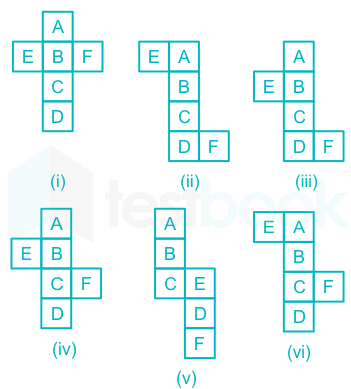
The clearly seen alternate position of the open dice becomes the opposite pair after folding and the two remaining faces also become opposite to each other.
Here, In every figure:
A is opposite to C.
B is opposite to D.
Thus the remaining, E is opposite to F.
 Important Points
Opposite pair of faces will never appear in the adjacent position in a dice.
EXPLANATION :
The alternate position of faces becomes opposite to each other, as shown below:

Option 1, 2 and 3 are not possible as they contain the opposite pair of faces.
CONCLUSION :
Hence, option 4 is the correct answer.
Given:
Height = 5 m
Cost of whitewashing 4 walls at Rs. 2.50 per sq m = Rs. 200
Cost of carpeting the floor = Rs. 5/m2
Calculation:
Let breadth be x meter
⇒ Length = 3x meter
Area of 2 walls along length side = 2 × height × length = 2 × 5 × 3x = 30x
Area of 2 walls along breadth side = 2 × height × breadth = 2 × 5 × x = 10x
Total area of 4 walls = 30x + 10x = 40x
Now, 40x × Rs. 2.5 = Rs. 200
⇒ 40x = 80
⇒ x = 2
Breadth = 2 meter
Length = 2 × 3 = 6 meter
Now, area of floor = length × breadth = (6 × 2) m2 = 12 m2
Cost of carpeting the floor at Rs. 5/m2 = 12 × 5 = Rs. 60
∴ Cost of carpeting the floor is Rs. 60
Given:
points (a, 0), (0, b) and (1, 1) are collinear.
Concept Used:
Condition for three points to be collinear is;
x1(y2 - y3) + x2(y3 - y1) + x3(y1 - y2) = 0
Here x1, x2, x3, y1, y2, y3 are the co-ordinates of the points.
Solution:
Let (x1, y1) = (a, 0), (x2, y2) = (0, b) and (x3, y3) = (1, 1)
We know that,
Condition for three points to be collinear is;
x1(y2 - y3) + x2(y3 - y1) + x3(y1 - y2) = 0
⇒ a (b - 1) + 0 (1 - 0) + 1 (0 - b) = 0
⇒ ab - a - b = 0
⇒ a + b = ab
\(\therefore\) Option 2 is correct.
Concept use:
Probability of an random event = Favourable no of outcomes/ total no of outcomes
Calculations:
Possible outcomes: 1, 2, 3, 4, 5, 6
Favourable outcomes = 2, 3, 5
Probability of Getting prime number = Favourable no of outcomes/ total no of outcomes = 3/6 = 1/2
Hence, option 2 is Correct.
Formula:
A = P × (1 - \(R\over 100\))T
where-
P = Present price
R = Rate of depriciation
T = Time
A = Price after T years
Calculation:
Substituting the value of rate in the depriciation equation-
⇒ 1,20,000 × (1 - \(12\over100\))2
⇒ 1,20,000 × \(44\over50\) × \(44\over50\)
⇒ Rs 92,928
The cost of the scooter after 2 years would be Rs 92,928.
Given:
Banu's monthly income is 25% higher than Ashok's monthly income.
Ashok's monthly income is 16% less than Imran's monthly income.
The difference of monthly income of Banu and Imran is ₹1350.
Formula used:
Let Imran's monthly income be I
Then, Ashok's monthly income, A = \(I × \left(1 - \frac{16}{100}\right) = I × 0.84\)
Banu's monthly income, B = \(A × \left(1 + \frac{25}{100}\right) = A × 1.25\)
Given, B - I = 1350
Calculation:
B = A × 1.25
B = I × 0.84 × 1.25 ..........(Putting the value of A)
B = I × 1.05
Given, B - I = 1350
⇒ I × 1.05 - I = 1350
⇒ I × (1.05 - 1) = 1350
⇒ I × 0.05 = 1350
⇒ I = \(\frac{1350}{0.05}\)
⇒ I = 27000
Ashok's monthly income A = I × 0.84
⇒ A = 27000 × 0.84
⇒ A = 22680
∴ The correct answer is option 3.
Given:
Average of 41 numbers = 58
Average of first 16 numbers = 46
Average of last 26 numbers = 66
Formula used:
New average = (Total sum - Excluded number) / (Total numbers - 1)
Calculation:
Average of 41 numbers = 58
Sum of 41 numbers = 41 × 58 = 2378
Average of first 16 numbers = 46
Sum of first 16 numbers = 16 × 46 = 736
Average of last 26 numbers = 66
Sum of last 26 numbers = 26 × 66 = 1716
16th number = 736 + 1716 - 2378 = 74
New sum = 2378 - 74 = 2304
New total numbers = 41 - 1 = 40
New average = 2304 / 40 = 57.6
∴ The new average is 57.6.
Given :- Sum of n terms of A.P. is \(S_n\).
Concept used :- Sum of n terms is \(S_n=a_1+a_2+a_3+...+a_n\).
Solution :- We have
\(S_n=a_1+a_2+a_3+...+a_n\) ..... (1)
and \(S_{n-1}=a_1+a_2+a_3+...+a_{n-1}\) ...(2)
Subtracting (1) from (2), we get
\(S_n-S_{n-1}=a_n\) which is nth term of an A.P.
Given:
A sum of money multiplies itself by 55 times in 2 years.
Interest is compounded annually.
Formula Used:
Compound Interest Formula: \(A = P (1 + \frac{r}{100})^n\)
Where,
A = Final Amount
P = Principal Amount
r = Rate of Interest per annum
n = Number of years
Calculation:
Given that the sum of money multiplies itself by 55 times in 2 years,
So, A = 55P
And, n = 2 years
Using the formula:
\(55P = P (1 + \frac{r}{100})^2\)
Dividing both sides by P, we get:
\(55 = (1 + \frac{r}{100})^2\)
Taking the square root of both sides:
\(\sqrt{55} = 1 + \frac{r}{100}\)
\(\sqrt{55} - 1 = \frac{r}{100}\)
⇒ r = \(100 (\sqrt{55} - 1)\)
Approximating \(\sqrt{55} ≈ 7.416\)
⇒ r = 100 (7.416 - 1)
⇒ r = 100 (6.416)
⇒ r ≈ 641.6
The correct answer is option 2.
Given:
The incomes of P, Q, and R are in the ratio 10 : 12 : 9.
The expenditures of P, Q, and R are in the ratio 12 : 15 : 8.
Q saves 25% of his income.
Formula Used:
Savings = Income - Expenditure
Calculation:
Let the incomes of P, Q, and R be 10x, 12x, and 9x respectively.
Let the expenditures of P, Q, and R be 12y, 15y, and 8y respectively.
Q saves 25% of his income:
Savings of Q = 0.25 × 12x = 3x
Expenditure of Q = Income of Q - Savings of Q
⇒ 15y = 12x - 3x
⇒ 15y = 9x
⇒ y = 9x/15 = 3x/5
Now, Expenditure of P = 12y = 12 × (3x/5) = 36x/5
Expenditure of R = 8y = 8 × (3x/5) = 24x/5
Savings of P = Income of P - Expenditure of P
⇒ Savings of P = 10x - 36x/5
⇒ Savings of P = (50x - 36x)/5
⇒ Savings of P = 14x/5
Savings of R = Income of R - Expenditure of R
⇒ Savings of R = 9x - 24x/5
⇒ Savings of R = (45x - 24x)/5
⇒ Savings of R = 21x/5
Ratio of the savings of P, Q, and R:
⇒ (14x/5) : 3x : (21x/5)
⇒ 14 : 15 : 21
The ratio of the savings of P, Q, and R is 14 : 15 : 21.
Concept:
1. Diagonal of a cube with side a is given by: a√3 = 50√3
2. Volume of the cube = Volume of the cuboid
Calculation:
We have,
⇒ a√3 = 50√3
⇒ a = 50 cm
Volume of the cube = a3 = 503
Volume of the cuboid = length × width × height
⇒ 50 × 25 × h = 503
⇒ 25 × h = 502
⇒ height = 502/25
⇒ height = 2500/25
⇒ height = 100 cm
∴ The height of the cuboid is 100 cm.
Given:
Speed on the first day = 18 km/h
Man reaches 6 minutes late.
Speed on the second day = 27 km/h
Man reaches 10 minutes early.
Difference in time = 6 + 10 = 16 minutes = 16/60 hours
Formula Used:
Distance = (Speed1 × Speed2 × Time Difference) / (Speed2 - Speed1)
Calculations:
Distance = (18 × 27 × 16/60) / (27 - 18)
= (18 × 27 × 4/15) / 9
= (18 × 27 × 4) / (15 × 9)
= 18 × 4 / 5
= 72 / 5
= 14.4 km
∴ The office is 14.4 km away from his house.
Given:
sin B + cos B = 5/4
Formula used:
(sin B + cos B)2 = sin2 B + cos2 B + 2sin B × cos B
sin2 B + cos2 B = 1
Calculation:
(5/4)2 = sin2 B + cos2 B + 2sin B × cos B
⇒ 25/16 = 1 + 2sin B × cos B
⇒ 25/16 - 1 = 2sin B × cos B
⇒ 25/16 - 16/16 = 2sin B × cos B
⇒ 9/16 = 2sin B × cos B
⇒ sin B × cos B = (9/16) / 2
⇒ sin B × cos B = 9/32
∴ The correct answer is option (2).
Given:
The ratio of mean and median of a data set = 2 : 3.
Formula Used:
Using the empirical relationship among mean, median, and mode:
\(Mean - Mode = 3(Mean - Median)\)
Calculation:
Let Mean = 2x and Median = 3x.
Using the formula:
2x - Mode = 3(2x - 3x)
⇒ 2x - Mode = 3(-x)
⇒ 2x - Mode = -3x
⇒ Mode = 5x
The ratio of Mode to Mean = Mode / Mean
⇒ (5x) / (2x)
⇒ 5 / 2
The ratio of Mode and Mean of the data set is 5 : 2.